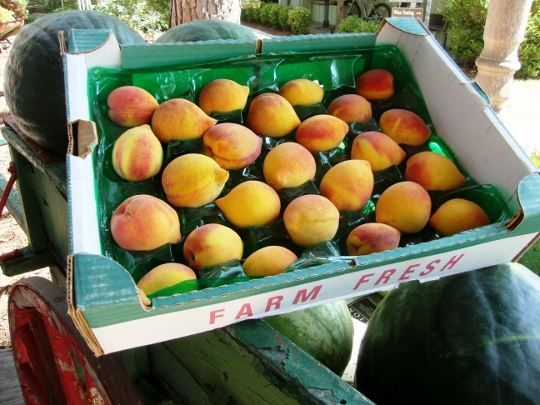
The following is an excerpt from Peaches: A Celebration of America’s Sweetest Season, just published as an ebook by Bright Sky Press. Here’s the Texas chapter, but I also traveled the backroads of Louisiana, Alabama, Georgia, South Carolina and even down into Florida, talking with peach growers - and tasting lots of peaches. Yes, I took all the photos. And yes, there are lots of terrific peach recipes. The book is available from Amazon and anywhere else ebooks are sold. http://www.amazon.com/Peaches-Celebration-Americas-Sweetest-Season/dp/1936474239
By JOHN DeMERS
“Work makes life sweet!”
You hear that a lot from the old German farm families of Gillespie County around Fredericksburg in the Texas Hill Country. Except, for the longest time, what you heard was “Arbeit macht das Leben Süß.” And for some of these families, work has made success in the peach business even sweeter. Just ask Mark Wieser, a high school teacher whose decision to hire one of his students inspired a multimillion-dollar international specialty food company. Just ask Donald Eckhardt, now technically retired but watching his college-educated kids grow peaches on land first planted by his parents. And ask Russ Studebaker, who came home to be a farmer in Texas from a life, perhaps in more ways than one, at sea.
“We get to benefit,” Donald’s daughter Diane tells me, squinting a bit beneath her UT cap in the bright summer sun, “from all the hard work my dad’s generation did, developing the reputation of Fredericksburg peaches. It’s such a good feeling to have people tell you these are the best peaches they’ve ever eaten.”
Diane and her family—like Russ Studebaker and his wife, Lori; their three sons; and Lori’s sister, Annette—spend their lives, especially between May and September, around the peach orchards and roadside stands that are their retail face. Yet perhaps no one knows more about this relationship than the local man who’s more or less graduated out of it. Mark Wieser says he never wanted much more from life than teaching school, growing peaches on his family’s land and selling them from a fruit stand he fabricated from an old log building—dubbed, logically enough, Das Peach Haus.
Mark put the Wieser in Fischer & Wieser, a Fredericksburg-based jelly and sauce company that now sells its products across the United States, Canada and the United Kingdom, with equal or greater success just around the corner in the so-called BRIC countries (Brazil, Russia, India and China). Yet Mark is as confident as anybody else that, while he might have been happy growing peaches and teaching, none of this business success would have happened without a single summertime hire.
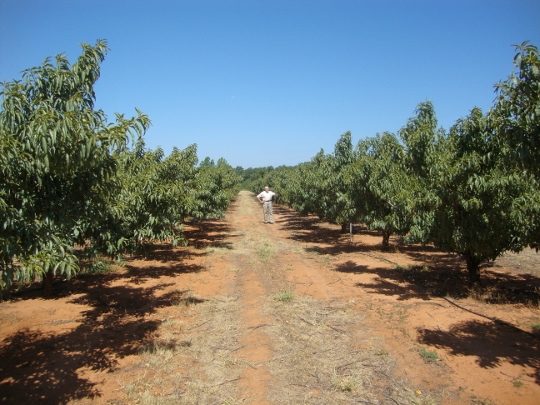
“I hired a lot of kids from my school to help pick peaches in the summer; it’s what you did in those days,” Mark remembers in his office at Das Peach Haus. “At my school I was also the tennis coach, and there was this kid always causing trouble on court six,” he laughs gently. “So I hired him to help me thrash agarita berries. I gave him his schedule that summer, but he was always hanging around willing to work. He was a sharp kid and a good team player. He was a natural. And I liked talking to him. That kid proved to be Case.”
It was Case Fischer, in fact, who first proposed “doing something” with the small jelly business Mark had started, Mark’s mother actually jarring the products made with peaches from the orchard and purchased from other local growers. Mark helped Case through Texas A&M with degrees in food science and marketing, and by 1986 they’d pushed past “Das Peach Haus” as a corporate name (though it’s still the name on their retail outlet in Fredericksburg) to become Fischer & Wieser.
Today Mark still owns about 1,200 peach trees growing in tidy rows behind Das Peach Haus. But in recent years, he has leased these to Russ Studebaker, whose sons pick the peaches all summer and deliver them in trays to the store. The process never lets Mark stray far from memories of his father, a lawyer and bookkeeper who came from Germany in 1914 and settled in Fredericksburg in 1917. The man always fancied himself a farmer and first tied the family’s fortune to this land, growing not only peaches but apples, plums and wine grapes. At one point early on, Mark’s father even mimeographed a letter suggesting peaches as an excellent crop to local farmers, surely one of the forces behind the Gillespie County industry now stretching between Fredericksburg and Stonewall.
Though some peach trees were planted in Texas by the original Spanish explorers (and by the Franciscan padres who also gave the Lone Star State the beginnings of its wine industry), the official history of the Texas peach began in the mid-1800s. Before that, there was only a tree here and a tree there, planted as seed carried from Tennessee or Mississippi by settlers hoping for a little variety in their diet of pork, venison and corn. These proto-peaches tended to be small, a trait still favored by some growers in East Texas for their appropriateness for canning. In local parlance, these are unsurpassed “pickling peaches.” Yet, back in the mid-1800s, the reviews were not so kind. “The peach was frequently seen,” wrote an Illinois lawyer named John James, “but it was a poor thing.”
In 1851 a man named Gilbert Onderdonk, who described himself as an invalid, moved from New York to south Texas for health reasons. In some ways, Onderdonk became the first of today’s tens of thousands of “winter Texans,” who annually appreciate the benefits of escaping the cold. Still, in lieu of reliance on an RV, a lounge chair and a fishing rod, Onderdonk quickly came to rely on agriculture.
The warmth and fresh air of the region must have agreed with him (though he credited the Mexican lemongrass tea he downed at regular intervals), for by 1870 Onderdonk had built a national reputation for his nursery growing Texas and Mexican plants. Among these he counted several varieties of peach, a type of fruit to which he devoted considerable research. There, ten miles west of tiny Victoria, lived one of the nation’s true peach experts.
As president of the Texas State Horticultural Society, Onderdonk carried the Texas peach gospel to the larger world in 1904, with an assist from the landmark Louisiana Purchase Exposition in St. Louis. This event (which also popularized such food-world staples as the hamburger, hot dog, peanut butter, iced tea, cotton candy and the waffle-style ice cream cone) let Texas show millions of fairgoers all that its agriculture had to offer. When the first shipment of perfect peaches from Smith Country arrived in St. Louis in mid-May, Onderdonk was inspired to record: “No shipment of fruit at the Horticultural Palace created such a sensation as these Elbertas. So early, so perfect, so luscious were they that the admiring fruit growers were amazed. Such a thing as an Elberta peach at that early date was not dreamed of.”
Equally amazing to those who cared about such things, the peaches from Texas kept arriving at the agricultural exhibit well into November, thus foreshadowing a modern peach season that begins in the hot, humid Rio Grande Valley and doesn’t end till all the peaches are picked as far north as the Red River. Clearly Texas was displaying the longest peach season in all of America, with Onderdonk and his fellow peach growers picking up the fair’s horticultural grand prize.
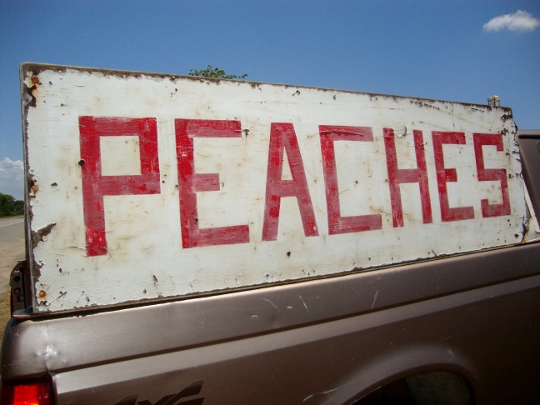
By 1910, inspired by their success in St. Louis, Texas peach orchards had an estimated ten million trees. Yet, then as now, nature had a vote in the process and cast it with a vengeance. Between late freezes and hail, insects and disease, inexperienced growers looking for a quick profit learned the hard way that Texas peaches were nobody’s sure thing. Trees perished, as did the growers who owned them, even before the Depression put extra strain on every sector of the national economy. And all the time Texas peaches were suffering, California peaches were enjoying their more stable, more comfortable climate.
Intriguingly, in recent years, even as Texas peaches have become more and more accessible at roadside stands and farmers’ markets in the state’s metropolitan areas, more and more residents of those areas are opting to go out to the orchards themselves. Consumer favorites include Cooper Farms in Fairfield and Ham Orchards in Terrell. Pick-your-own places have also become popular, despite Mark Wieser’s caveat: “Never squeeze peaches. It hurts their feelings.”
Orchards in the Hill Country service Austin and San Antonio, with those in Montgomery and Brazoria counties tending to Houstonians. Parker County finds avid fans in Fort Worth, and Smith delights Dallas residents with one of the largest peach crops in the state. As with several other crops, only El Paso has to look beyond Texas for its peaches, finding a better and definitely closer supply just across the line in New Mexico.
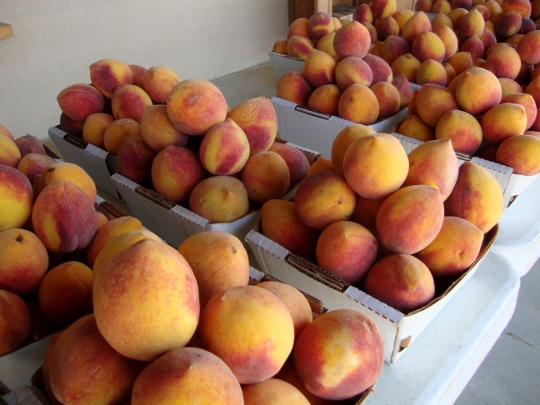
Back in Gillespie County though, the long, hot, dry summer burns on—making, as locals will tell you, the peaches even sweeter. And proximity being the mother of non-retirement, Donald Eckhardt turns up at the roadside stand to see how the kids are doing. On this day, the “kids” include his daughter Diane plus Beau Cox, who’s married to his other daughter, Debbie, who went to college for finance and has a day job. Alerted that a visitor might happen by to talk family history, Donald has filled four pages with his tightly knit scrawl.
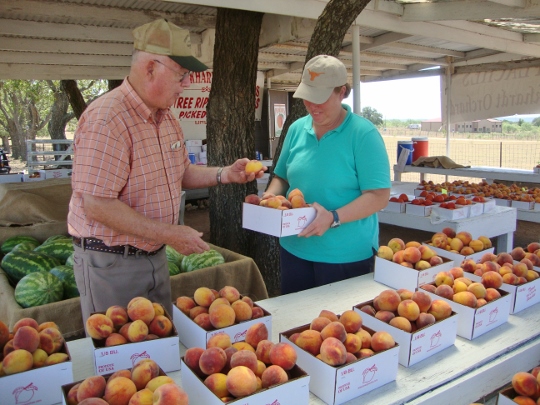
“My parents started farming and ranching around here in the early ’30s, with the focus on peaches by 1936,” he tells me, not really looking at his notes. “They had six acres and planted about 300 peach trees. There was drought sometimes, but most of the trouble was late spring frost, and that happened several times in 75 years. But all in all, we’ve been blessed with real good crops.”
Donald’s parents retired in the 1960s, letting him and his wife take over the orchards—building up to about 100 acres, 90 percent planted with peaches, plus a small number of plum trees. The varieties have evolved, too, he says, with virtually no peaches his parents grew still in production. Favorites now include Dixieland and Loring, both of which he says are “superior in quality and flavor.” Once his daughters took over in 2002, Donald watched the total peach acreage shrink to a more manageable 40 or 50, virtually all of the fruit reaching a hungry public via this retail stand.
While her father is speaking, Diane stands beside him, nodding from time to time, reminding him of this or that, and letting Beau handle the customers who pull onto the gravel off Highway 87 heading south toward Comfort. Finally, listening to the Eckhardt generational saga, she realizes it’s her chapter. “My sister and I went off and got college degrees in something else,” Diane says, hers in biology and nursing, “but you miss what you did when you were a kid with your family.” She thinks a moment, glancing down at her dad. “It always draws you back.”
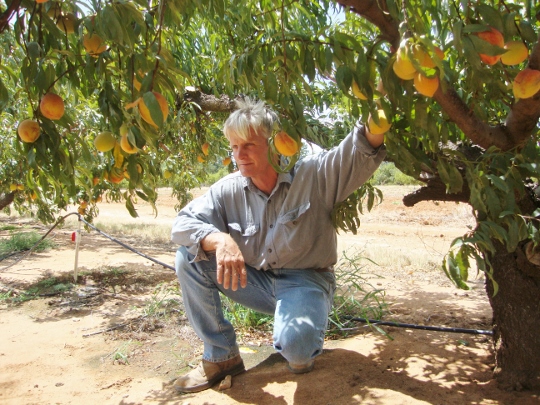
Russ Studebaker’s eight generations of farming history drew him to the peach orchards of Gillespie County—but only later in life. He grew up among the citrus groves of the Rio Grande Valley, but sensing little opportunity there, he joined the Merchant Marine for 20 years. Over those long decades of work on tankers and tugs, Russ started buying land between Fredericksburg and Stonewall as an investment, “because it was cheap,” he fills in. While he wasn’t sure when, or even if, his family would farm it, he no doubt took direction from the fact that generations of Studebakers had been farmers in America since the 1730s. They started in Pennsylvania, Ohio and Indiana. Russ says his grandfather “meandered” down to Texas during the Great Depression via the Dust Bowl in Kansas and Missouri.
Today, Studebaker Farm grows a wide variety of crops, including about 3,000 peach trees, whose 34 varieties keep the season going from May well into September. Spirited about progress, at any given moment Russ can show you some new technique or piece of equipment he’s trying out for the state. And as a one-man agricultural Answer Man, he can tell you exactly what he hopes it will do for his crops and his family’s future. Despite the 100-degree temperatures, he has even been building a permanent structure just behind the tents on Highway 290 where Lori and Annette sell fruit. When the building is ready next season, he says, the sisters will be able to offer the peach ice cream they’ve been perfecting. My sample bowl at Russ’s house makes this a happy prospect indeed.
“It’s funny,” he reflects. “I went to sea to get away from all this farming. And then I used the money I made at sea to get me right back on a farm. It’s a good life for my family, though. I really believe my sons are better off, getting up and working every day. I see them developing responsibility, a sense of discipline. I’m not so sure they’d been doing that in any other life.”


Recent Comments