Houston Weekend on Wheels

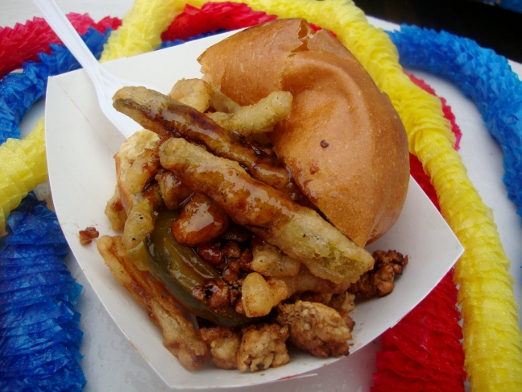
The skies were gray and the drizzles recurring today at the Haute Wheels Houston Food Truck Festival. Yet neither of those things could prevent a Bastille-style storming of the 35 or so participants and their oh-so-edible wares. Based on the line to buy tickets, the line to trade online paperwork for tickets, the line to get into the gates and the line outside most of the trucks, Haute Wheels is clearly a big success. As far as I’m concerned, the best newcomer this year is Big Daddy Z’s, which served this Jamaican-flavored jerk pork sandwich with fried jalapeno and onion strings. And you get lei-ed while you’re at it!
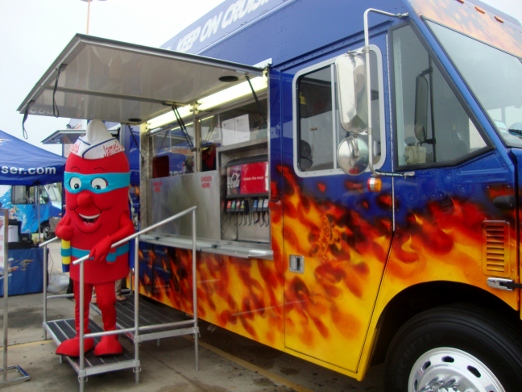
Haute Wheels, which picks up again tomorrow at the HCC campus on the 610 Loop, is also a lot of people’s introductuion to the new ConeyCruiser, a creation of James Coney Island that’s described as the largest food truck in Texas. According to JCI president Darrin Straughan, on hand for the festival, the Coney is no effort to mimic the chef-driven trucks so popular these days but to deliver the branded coney dogs to diners in less familiar settings.
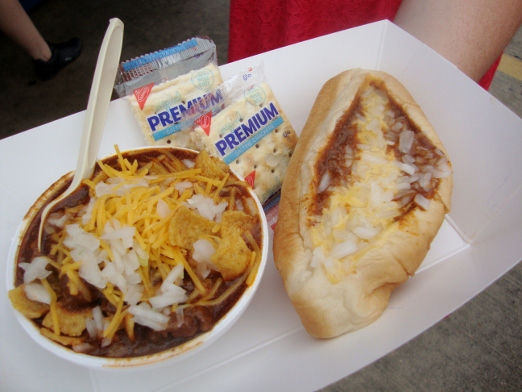
“Our truck,” says Straughan, “is very popular as a ‘shabby chic venue’ for private parties and company events, and its kitchen is equipped to produce all types of menu items.” For Haute Wheels, James Coney opted out of venturing too far from the tried-and-true, showcasing not only the original coney with chili, cheese and onion but its variation on traditional Texas Frito pie. This is a brand-new truck, you might say, with 90 years of experience.
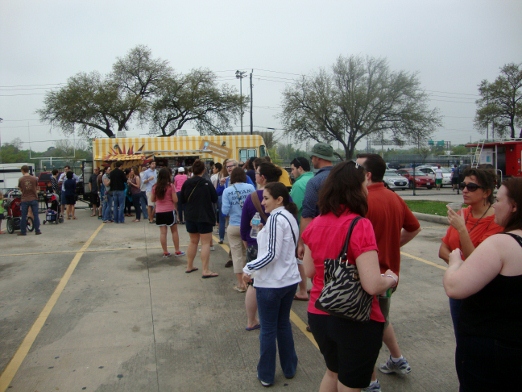
As in years past, part of the challenge of putting on a food truck festival is getting the trucks themselves to deliver what the customers demand. After all, as a customer, once you’ve bought a ticket and made your way inside, your business is with the individual trucks, some of whom accept credit cards and some of whom demand cash. More tellingly, some have worked through menu issues to the point they can cook and serve quickly, and others have not. Finally, some trucks simply have a bigger following than others.
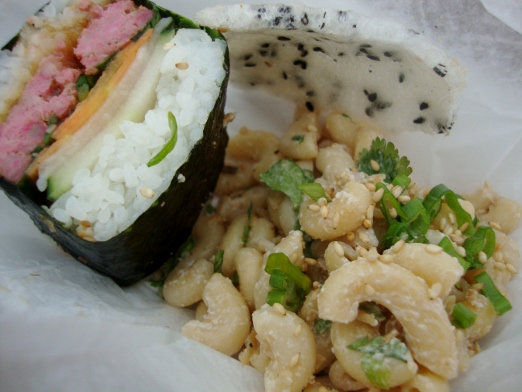
So… when is SPAM more like sushi? Answer: when it comes from the Vietnamese fusion food truck MiSuBi. In this particular sandwich, accompanied by Asian-tasting elbow macaroni coated with sesame seeds, the all-American meat product is rolled up in seaweed with plenty of crunchy vegetables. Bold Asian flavors also play a big role at Coreanos (Mexican with Korean) and a handful of other festival participants.
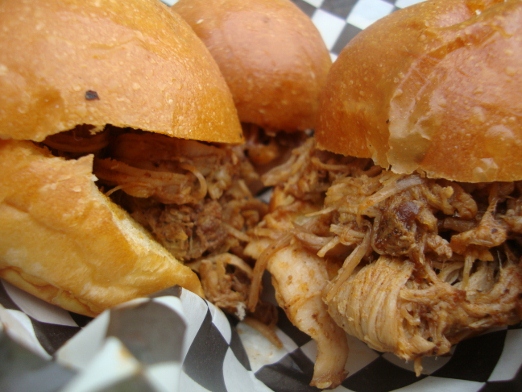
Though it’s not always obvious, one of the more interesting aspects of the food truck movement is the varying degrees of professionalism behind the food. Some successful trucks are just people who always wanted to do something like this, maybe even parttime. Others, like Fraiche, are the work of professionals. These pulled pork sliders, for instance, are the creation of a trained chef and a trained pastry chef.
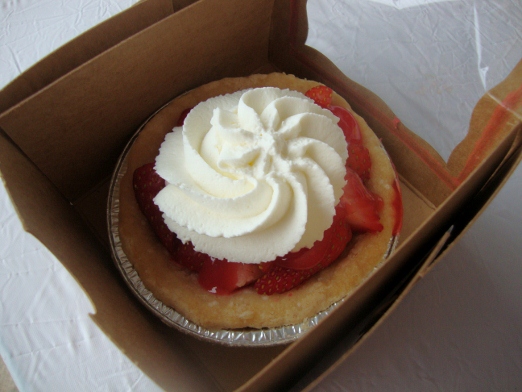
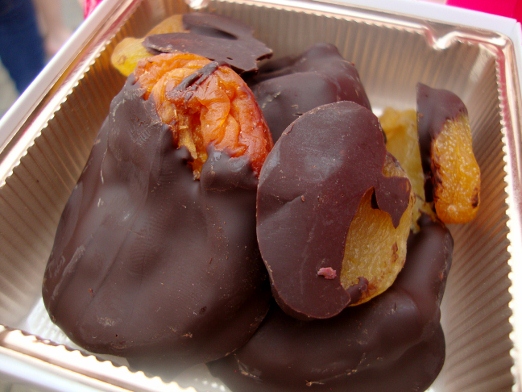
Dessert seemed a happy choice at Haute Wheels today: first, because it was easy to get sweet at the festival when the rest of the multitudes were gorging on savory. And second, because desserts have to be made in advance. Who, after all, wants a Bananas Foster truck, if each order has to be flambeed before your eyes? Above we have a light and wonderful strawberry pie from Porch Swing Desserts, below a box of Belgian-inspired confections of dried fruit and chocolate from Chocolat d’Arte.

Munching Along the Midway

Year after year, since the competition kicked off five years ago, I’ve loved helping judge the Gold Buckle Foodie Awards at the Houston Livestock Show and Rodeo. After all, I have the other 364 days to go on a diet. How else can I hope to taste nearly all the foods served by vendors on the midway and in the mammoth exhibition hall? And how else can I hope to locate instant classics like these Red Velvet Frosty Bites by Custom Confections, the iconic cake baked in a cup, filled with cold ice cream and topped with what amounts to cheesecake icing. These Bites, by the way, convinced us judges to give them the top award in the category titled Most Creative Food.

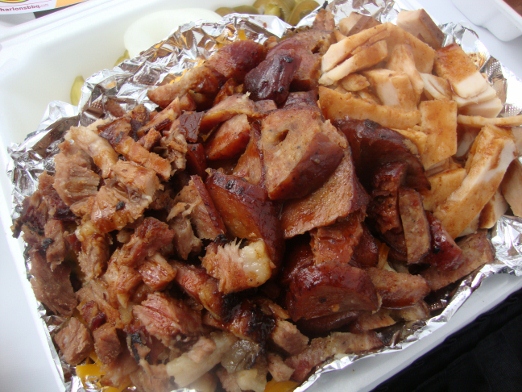
At a rodeo, or a carnival, or anything else serving what’s come to be lionized as “fair food,” some dishes aren’t so much Creative as they are just Big. That certainly applies to this Super Baked Potato from Harlon’s BBQ. I believe the potato itself is large, even though it’s pretty hard to locate it under this onslaught of smoked beef brisket, sausage and turkey. I, for one, love that each meat has a kind of “zone” to itself. Very orderly, that way. This baked potato, which I rated even higher personally, took home third place in the Best Value Food category, behind the Ribs and Chicken Platter from Saltgrass Steakhouse in first and the Pizza on a Stick from Swain’s in second.

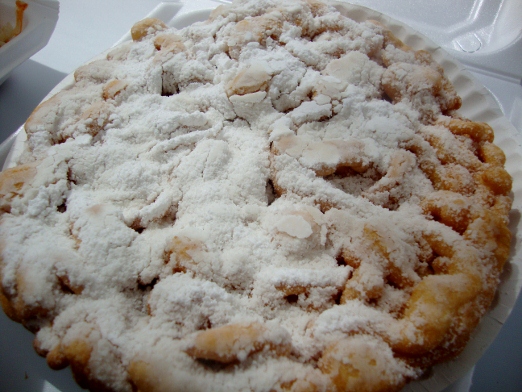
I found myself wondering yesterday, as dish after dish appeared before me, when in history “more” became indisputably better - when a corndog had to have chili and cheese ladled over the top or, even worse, when a cheeseburger had to be bunned, battered and deep-fried. When confronted with a simple, straightforward funnel cake topped with powdered sugar, I wondered if some things weren’t created by God to be exactly what they are. Then again, we judges did give a second place in Most Creative Food to a Donut Double Bacon Cheeseburger, with a glazed donut where the bun ought to be.

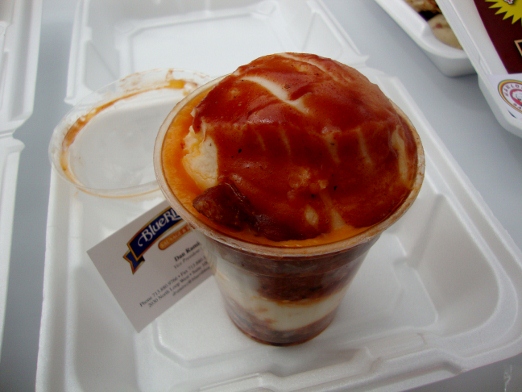
I don’t think I’ve ever seen the phrase trompe l’oeil used on a sign at the rodeo, and since “potato” comes out “potatoe” often as not, I’m not so sure I want to. But one of my favorites has got to be this fool-your-eye spin on an ice cream sundae. The ice cream is mashed potato/e, while the topping is BBQ beef, and the chocolate sauce is, naturally, replaced here by barbecue. As required (by me) for this sort of thing, the creation from Frankie B. Mandola at Bum’s Blue Ribbon Grill is not only clever but delicious.

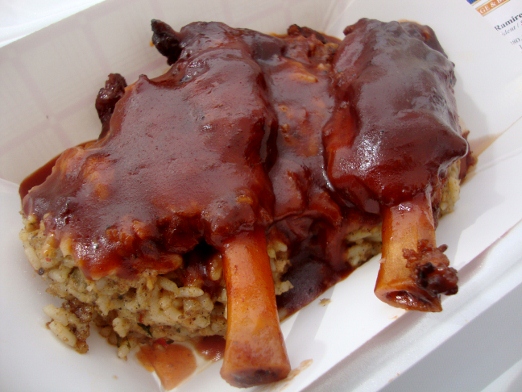
Frankie B. doesn’t need to cry for me or for Argentina, for not winning an award for the sundae - which did cause quite a stir when it first appeared a year or two ago. This year Bum’s Blue Ribbon Grill picked up a second in Best New Flavor for these Grilled Pork Ribees with Dirty Rice. I loved this one, especially the exemplary Dirty Rice. It came in right behind the Cookie Dough Parfait from Aunt Edmoe’s and right ahead of the Do-E-Oreo from a vendor called Fried What! Spelling and punctuation are theirs, not mine…

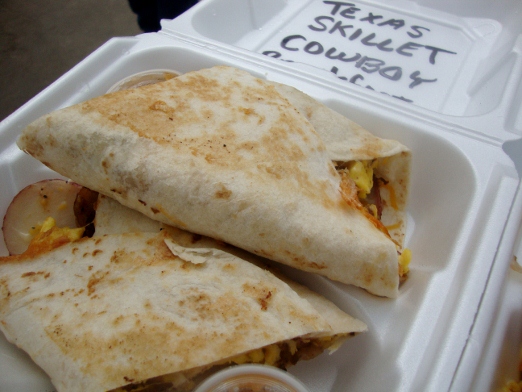
For the Rodeo’s nearly 30,000 volunteers, days can get started mighty early. And that means that, when it comes to food, they are the midway’s “first responders.” One of the breakfast dishes they are - not surprisingly - responding to best this year is this Cowboy Breakfast from Texas Skillet. It was the first item to arrive at our judging table, and (since judges start off hungry in hopes of survival) we were very happy to see it. We gave it second place in the Best Breakfast Food category, topped by the Big Stone Breakfast Sandwich from Stubby’s Cinnamon Rolls and followed by the Breakfast Taco from Burton Sausage Co.

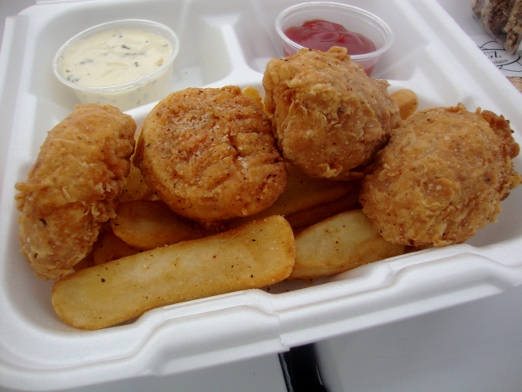
These deep-fried (or were they chicken-fried, like half the other things at Rodeo?) deviled eggs were part breakfast and part appetizer. It was, generally, considered a cool idea - not least because most of us are familiar with the sausage-laden “Scotch eggs” so popular in Great Britain. Maybe next year we’ll see some Deviled Scotch Eggs. Nobody ever made us judges hate them by adding sausage to anything. And while we’re at it, Fried Food honors went to the Original Corny Dog from new vendor Fletcher’s, followed by the Fried Brownie Ball with Ice Cream from Custom Confections (yes, they of those red velvet cupcakes) and the Fried Oreos from Still’s Funnel Cakes.

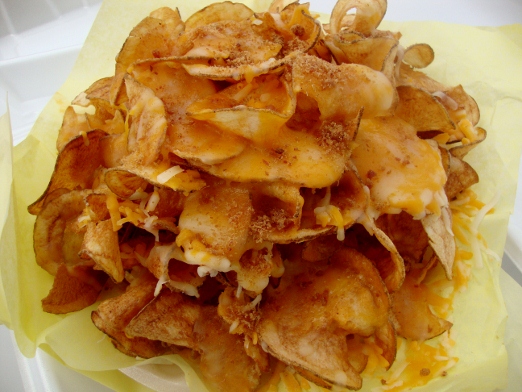
How on earth did I get off the Rodeo grounds without taking a photo of anything on a stick? We did judge a sausage on a stick that was about two feet long, with all the resultant obscene remarks. But while you’re eating these gooey-delicious loaded potato chips, I can tell you that the Food on a Stick category ended up with Shrimp Diablo from Berryhill Baja Grill in the top spot, followed by Pizza on a Stick from Swain’s and The Big Rib from RCS Carnival.

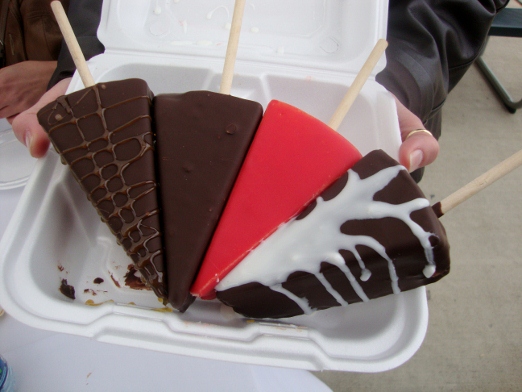
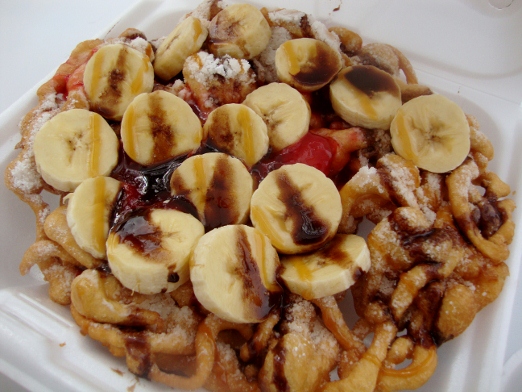
And while none of my personal favorites took home awards in it, that leaves only the official Best Dessert category. Winners were the surprisingly simple Cinnamon Glazed Pecans from Go Nuts and More in first, Apple Slices with Caramel from Carmelot (I DO like the name!) in second, and traditional Apple Pie & Blue Bell Homemade Vanilla in third. All good, obviously. But what I really liked best - other than those cupcakes - were the frozen cheesecakes on a stick pictured above and the funnel cake topped with bananas just below. You see, bananas! Really now, who ever said you couldn’t eat healthy at the Houston Rodeo?


The Master of Avery Island

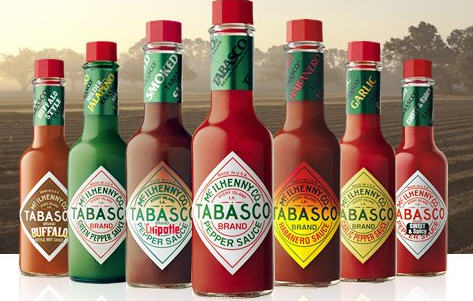
When former Tabasco president Paul McIlhenny is laid to rest this coming Wednesday, a lot of people will remember a lot of things about him - his immense love of food and drink, his support of chefs from anywhere but especially from Louisiana, his concern for his state’s endangered wetlands and, of course, his promotion of that famous pepper sauce until the iconic product was sold in 165 countries.

I’ll mostly remember him for the ties.

Sure, one of the primary “takes” of Louisiana food tourism is a visit to the McIlhnennys’ Avery Island near New Iberia, a peppery pilgrimage I made several times. Like the sweet garlic that rides the air currents when you drive through Gilroy, Calif., or the muscat wine that perfumes your every breath in the French town of Beaumes de Venise, the aroma of peppers, vinegar and salt always made me hungry whenever I visited the place Tabasco was made. But whenever I visited Paul himself, is his office highrise in New Orleans, he always took me to a drawer, pulled it open and said with a wide grin, “Take as many as you like.”

What that drawer contained, in abundance and in variety, was branded Tabasco neckties, some that screamed “walking advertisement” and others that were much more subtle. You have to understand: I did a weekly TV show in New Orleans for many years, talking about food naturally, and it got where the only ties I wore on the air were Tabasco ties. To me, it was a “food statement.” To Paul McIlhenny, it was the sort of thing he’d been doing since his birth (in Houston, no less) in 1944. He and I had a running gag about the Tabasco boxer shorts that filled the drawer next door. “I’d take some, Paul,” I said even after the joke was very old, “except nobody will ever see them on TV.”

Tabasco sauce, however - Paul would tirelessly correct me: it was “Tabasco brand pepper sauce”- and not ties, boxer shorts or aprons, remained the McIlhennys primary product from the day the company was founded on Avery Island in 1868. Edmund McIlhenny deserves the credit for that, though several of his successors deserve kudos for making the stuff a household word. During the world wars that formed the 20th century, and all the way through Korea and Vietnam, Tabasco followed American GIs into battle. It was either a taste of home or a taste they’d want at home for the rest of their lives. As Paul liked to put it, “We’re defending the world against bland food.”

To that end, he would spend time regularly with all of us who wrote or broadcast about the world of eating or drinking. Sometimes it was to champion an aspiring Louisiana chef (who no doubt was using Tabasco in his signature creations) and sometimes just to take the culinary temperature. And then, there were the launches, following the American taste buds into variations on the family theme like jalapeno (which had the nerve to be green in that oh-so-recognizable bottle) and even smoke-kissed chipotle. Salesman that he was from birth till death, Paul understood that the more things people thought his pepper sauces were good on, the more of his sauces we’d want, use and buy.

At one such dinner - they were always held at nifty, expensive places like Ruth’s Chris Steakhouse - I may have given Paul an application he hadn’t thought of, or maybe he was just being nice. He was ending an extended homily about how great his classic red sauce is on the fried eggs that Americans were still supposed (in his mind) to eat for breakfast every morning. He was right, if you haven’t tried it. Tired of being one-upped, however, I informed him that my favorite combination was Tabasco’s green jalapeno sauce on corn on the cob, with butter or even without.

“Wow,” Paul uttered after a long pause, visibly running the flavors of juicy corn and the hot-salty-pleasantly-vegetal liquid through his mind’s gifted, globe-trotting taste buds. “Yeah,” he said slowly, as though the fate of the free world depended on it. “That would work.”


Happy Birthday to Sullivan’s

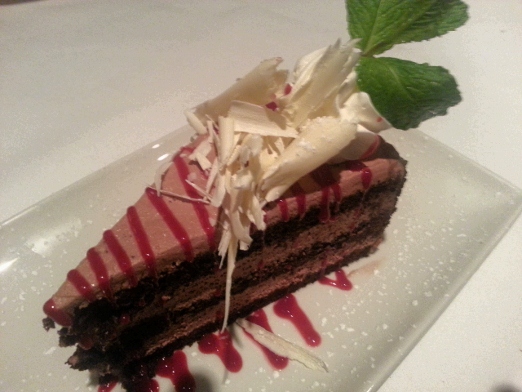
I actually do love birthdays, mine or anybody else’s, even though I often forget what date they fall on or exactly what I’m supposed to do about it. But when it comes to Sullivan’s Steakhouse, celebrating its 15th birthday in Houston, I know what to do: go there to eat and drink. Which is exactly what happened to me last night. And as you can see above, the folks at Sullivan’s were thoughtful enough to bake their own chocolate mousse birthday cake.

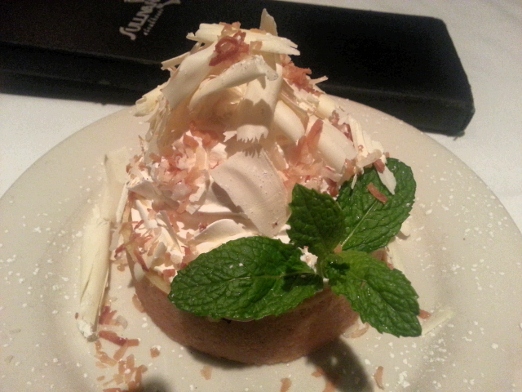
Then again, if you go to Sullivan’s between now and the end of the month, no one will force you to have birthday cake for dessert. Good days or bad, in fact, I’ve always been partial to this un-pie-shaped coconut cream pie. There is a smooth and, of course, creamy coconutty filling inside what’s more like a ring than a crust, plus shavings of what is or ought to be white chocolate. Sullivan’s also turns out a nifty version of key lime pie. As a guy who wishes he were in the Florida Keys approximately every 12 1/2 minutes, I had to have that too.

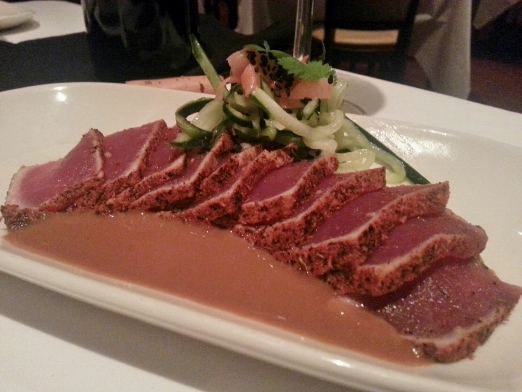
One of the joys of last night’s dinner was catching up with regional executive chef Aristotelis Trikilis, or Chef Teli for short. Though based in Houston, Teli is responsible to all the Sullivan’s on the West Coast, which means (as it puts it in his rumbling, rolling Greek accent) from Alaska to Tucson - and Houston, naturally, with executive chefs and sous chefs in each restaurant. Somewhere in all of his travels, Teli manages to create, perfect and approve wonderful dishes like this tuna tartare appetizer, crusted with Cajun seasoning and set atop pungent English mustard sauce.

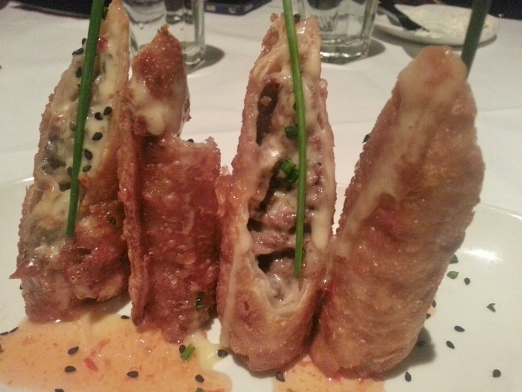
Chatting last night with still-new Houston GM Alex Truong, I realized that the Sullivan’s story keeps getting, in those words from Wonderland, curioser and curioser. Sullivan’s has traditionally been the less expensive, slightly more everyday and, in some ways, less frilly sibling of Del Frisco’s Double Eagle Steakhouse. Still, in the next month or so, these two concepts will be joined by a third that’s more casual and less expensive still: Del Frisco’s Grille, opening in the lively West Ave development. As such, Sullivan’s will become the corporation’s “middle child,” and it should be fascinating to see how all those things shake out. And yes, the nature of things let’s Sullivan’s spin its own version of popular Del Frisco’s items, like these almost over-indulgent cheesesteak eggrolls with sweet-spicy chili sauce and honey mustard.

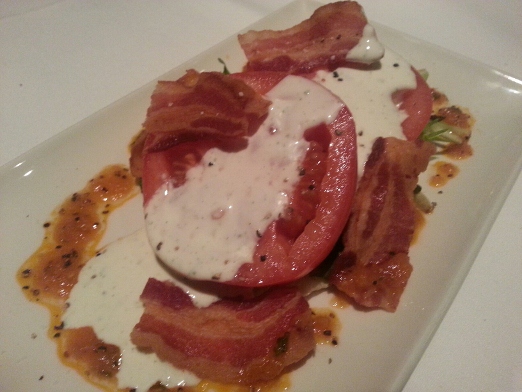
Salads at Sullivans are a case of something old and something new. Surely the classic within these walls is the iceberg wedge, preferably with bleu cheese dressing and crumbled bleu cheese on top of that. That’s still amazing, for me a blast from the past since such salads were part of my earliest memories of oldtime, family-friendly steakhouses. But I love the newer BLT salad even more, complete with both roasted tomato and garlic ranch dressings. And did I mention applewood-smoked bacon?

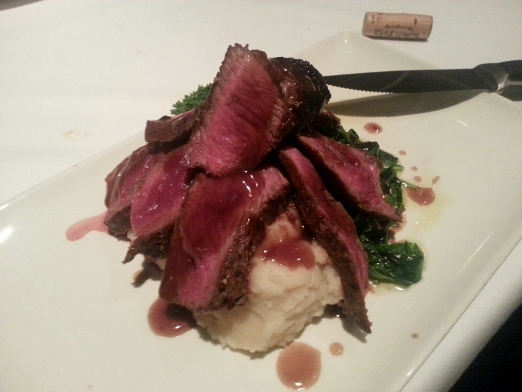
A similar thing happens with the steaks at Sullivan’s. You can get any traditional cut of beef, from filet mignon to New York or KC Strip to ribeye to porterhouse (the latter my favorite, solely because the late Ruth Fertel told me that’s what she liked best!). But Chef Teli concocted something a little special: slices of New York strip with what I believe he said was a porcini or other mushroom crust, displayed rather artfully atop horseradish mashed potatoes. Even this porterhouse lover couldn’t resist.

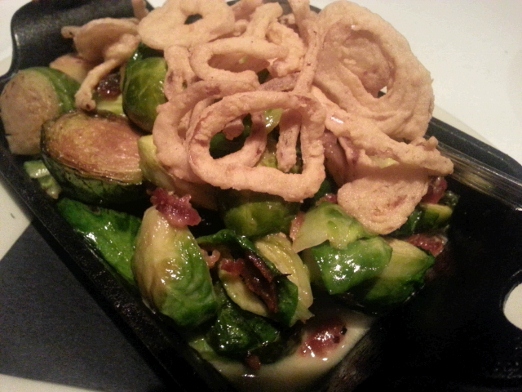
Sides are a pretty big deal at Sullivan’s, even though not quite as big a deal as they are at, say, Del Frisco’s. Above we have what I call Brussels sprouts 101, meaning the tiny cabbages cooked with no small amount of bacon. They are, in short, Brussels sprouts for peoplke who don’t like Brussels sprouts. As with white zinfandel and other “starter wines,” I guess we should be grateful for the introduction. And putting fried “shallot rings” on top doesn’t hurt either.

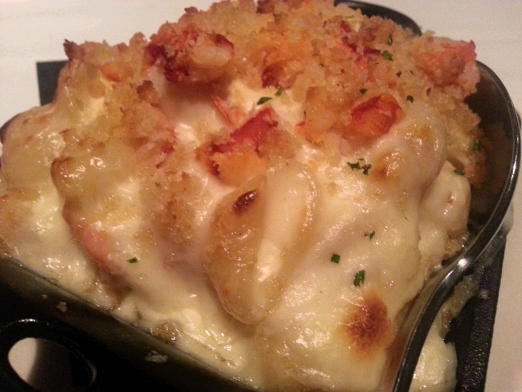
One of the things steakhouses love to do these days is find a classic home-cooked dish and upgrade it beyond what anybody would ever do at home. The goal is a sense of celebration, and affluence is primarily what such dishes celebrate. That fact that, on so many nights, the dining room at Sullivan’s is replete with Houston Texans, Rockets and Astros is, therefore, no accident. My feeling about such dishes not withstanding, it’s hard not to dig into Sullivan’s crusty-topped lobster mac and cheese. I’m just happy nobody assaulted it with truffle oil!

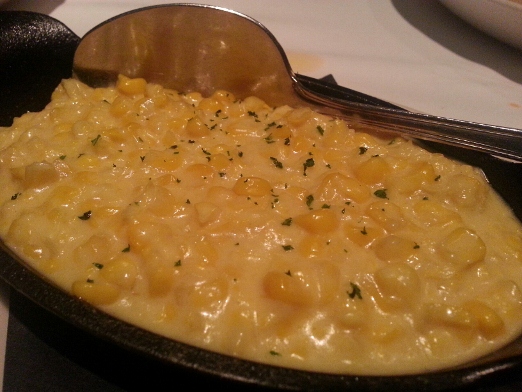
Every so often, however, affluence-celebrating restaurants like Sullivan’s - and higher-ups like Del Frisco’s but also lower-downs like Del Frisco’s Grille - figure out how to leave well enough alone. Thus one of my favorite dishes Chef Teli, GM Alex and charming server Jessica set before me was this creamed corn. No lobster, no truffle oil, no caviar or foie gras. Simply kernels of sweet corn in what I assume is plenty of cream and butter, the way it might be made on a farm with plenty of those things and no money changing hands at all. That’s a welcome reminder when we’re celebrating a birthday - be it Sullivan’s, somebody else’s, or even our own.


Sunday Supper at Liberty

In this life, nothing’s harder to displace than a memory. For me, “Sunday supper” has always been my late father (and my late mother too, since we’re conjuring) making pizza in the kitchen while we kids watched Walt Disney’s Wonderful World of Color - on our black-and-white TV. My father always started by sauteing Italian sausage, thinly sliced bell pepper and chopped mushrooms, throwing off an aroma that still makes quick work of the decades in between. From now on, however, Sunday supper just might be these “crazy” grilled oysters topped with “bacon jam” at Houston’s Liberty Kitchen.

As long as we’re talking memory, I do believe Liberty Kitchen serves the best sliders I’ve ever tasted. And I speak with some authority, since I grew up eating at a variation on White Castle known in New Orleans as Royal Castle and had my first “real” job in college bopping between the burger grill and the French fryer at the super-busy McDonald’s across from the old Boston Garden. At Liberty, the ratio of meat to cheese to bun is, well, perfect, as are those lovely swatches of ketchup, mustard, pickle and diced onion. The fries hidden behind this happy trio - according to this expert - are amazing too.

Liberty Kitchen, which opened in the Heights some months ago, is the culinary vision of chef-owner Lance Fegen, with whom I recall many a long, rambling conversation about food, drink and service at the end of the night at downtown’s Zula a dozen years ago. Besides taking a couple years “off” to surf in Costa Rica, there have been a few itirations of Lance since then, including Glass Wall and BRC. In terms of both partnership and philosophy, the route from BRC to Liberty Kitchen is an unbroken line. There’s a big menu of things people love to eat. Take these fried onion rings, for instance. On second thought, get your own.

When I have these fried green tomatoes topped with crabmeat and sided with grilled shrimp in my mouth, I think Liberty’s Sunday supper is special. But really, this dish and 99% of the others are available all day every day - apparently another lesson Lance learned on the way to making people happy with food and drink. People are so happy with Liberty Kitchen, in fact, that plans are already in motion to open a second location on San Felipe near the St. Regis or the Target, depending on your tax bracket. They’re opening in the old Vivo space, which then became the Vida space, which then became the empty space. A lot of folks in that neighborhood can’t wait.

So yes, there is beef brisket on the menu at Liberty Kitchen - but it’s about as far from Texas BBQ as Transylvanian-born, Jewish-deli pastrami might be. The seasonings are completely different from our local “dry rub,” and it’s roasted instead of “low and slow” smoked. It’s a terrific rendition, though, the meat fork-tender under that great big glistening knife you don’t need, and even better when dunked into the mushroom gravy. You get to choose your side with the brisket and any other entree here. You can do lots worse than the potato hash made lush with melted white cheddar.

I have the add that, if you really need more bacon in your diet, you can always add a healthy vegetable like asparagus. The “bacon jam” reappears here from the grilled oysters, and presumably from any other item you ask Liberty Kitchen to put it on. The place, in fact, has lots of bacon-worthy side dishes, both included and extra. The one thing I love that they don’t seem to have is some over-the-top creamed corn - or, in southwest Louisiana parlance, maque choux. Every time I eat at Liberty Kitchen, they make me want some right now.

To me, Lance Fegen and chef-on-duty Travis Lenig are all about savory. But you can’t really overindulge on savory without doing the same on sweet. Well, actually, I can - but I take it that most people can’t or won’t. So that means that, without stooping to those oversized Texas desserts allegedly “for sharing,” Liberty Kitchen needs and has some fairly eye-popping finales. Whenever I remember this moist Italian cream cake from my Sunday supper, maybe belt-popping is more like it.

And finally, while I make a better-than-decent bread pudding based on my New Orleans roots - especially my homage to the pina colada - I’m ready to pack up my baking stuff and go home after tasting Liberty Kitchen’s raspberry white chocolate version. It’s a bit like the sliders: the perfect amount of everything balanced with the perfect amount of everything else. If my father had made this as we watched color TV in black-and-white, or if McDonald’s had made this across from the old Boston Garden, weighing 300 pounds would surely be way worse than a memory.


Raw Emotion at Houston’s Cove

Philippe Gaston (well, Jean-Philippe Gaston, to be precise, preferably with an accent) is just your typical French chef who learned to cook Asian food while living in Mexico - and then perfected his most exotic techniques at Japanese stalwarts like Soma and Kata Robata in Houston. With such a tangled culinary bloodline, nothing Gaston does should come as a surprise. Unless, of course, it’s carving out a multi-national raw bar inside another successful Houston restaurant called Haven.

“So Randy and I were wondering,” the chef told me last night, referring to Haven honcho Randy Evans, “why there were no actual raw bars here in Houston when we’re this close to the coast. And we both know there are raw bars every block or two in New York City.” With Gaston’s background in sushi and sashimi, plus a lot of ambient awareness of ceviches, Italian crudi and other raw or nearly raw seafood specialties, the road to something called Cove seemed clear enough.

At the new place, there’s absolutely no “fire in the hole” - no stove or oven or even microwave behind the line, which mostly seems like a sushi bar meets cocktail bar anyway. Anything cooked, like the boiled shrimp that come in a bowl where that fancy tower thing might be or the handful of desserts Gaston makes himself, has to be carted over from the Haven kitchen. Still that leaves wonders like the Ika Mata (from Rarotonga in the Cook Islands) and the Poisson Cru from Tahiti in Fiji (both pictured above, both delicious settings of red albacore in the first and golden snapper in the second).

One of the more striking-looking dishes (all of which, by the way, are divided according to their region of origin) is called PNWS. Hailing from the Pacific Northwest, it naturally is salmon - the delicate fish quick-cured and served with lemon-lime zest, brown sugar, caperberry salt, chile peppers and three upright leaves of candied hoja santa. It takes a moment, this being Texas, to understand that the leaves are not some newfangled form of tortilla chip.

One real Cove signature is the Greek-inspired oktapodi krasato. Yep, octopus. Even if you think you hate octopus - indeed, even if you have hated octopus - you need to give this dish a try. The seafood itself is young, which I suppose makes it more tender, as does marination. (As does beating against rocks, the way the old ladies do in Greece!) It is cooked and brought into the Cove space in the simplest blend of olive oil and red wine vinegar, with a totally Greek sprinkle of thyme and oregano.

Yes, Cove is a “small plate” kind of place, so you and friends can sample a lot of items with your wine, beer and cocktails. But no, it’s not 100% seafood. In addition to the beef tataki from Japan pictured at the very top, there’s a beef heart carpaccio that should make a believer out of anybody. A quick reminder to the squeamish: heart is muscle, not organ - so it tastes and feels like meat. Sliced paper-thin with lemon vinaigrette, parmesan, caperberry and shallot, it’s also tastes like some of the best carpaccio between here and Harry’s Bar in Venice.

Not being a baker by trade, Gaston does his best to come up with desserts that aren’t too much like baking. Really, he accomplishes his goal impressively, all things considered. Our first dessert to sample was the ginger brulee, the custard scented with fresh ginger (still playing around with Asia, obviously) and outfitted with dried cranberry and gingersnap crumble. Best of all, the custard was lush and creamy.

As a “pastry chef,” Gaston pretty much likes to crumble and crack. In a delicious echo of the gingersnap crumble with the ginger brulee, his version of key lime pie isn’t a pie at all. It shows up with graham cracker “soil” where the crust should be. The “pie” itself is, therefore, more of formed quennelle. And smashed up pieces of Swiss meringue dot the landscape. All in all, I can’t wait to see how Cove does - and what it does for Haven. It’s a delightful, comfortable, intimate space in which you forget you’re inside a large, busy restaurant. It’s a fascinating idea I want to eat more of, however many wandering roads the chef had to travel to get here.


Making Waves in the Desert

The sun dips lower toward the mountains to the west, letting a few clouds bend and slant rays of golden light across the courtyard. It’s another beautiful dusk at the Gage Hotel in the Far West Texas town of Marathon (pop. 350, but nobody seems to be counting). And new executive chef Brandon Waddell is in the kitchen. At least he was in the kitchen, until he found me sipping a pinot grigio in the courtyard and started delivering appetizers. This campechana (a kind of Tex-Mex shrimp cocktail, with lovely white lumps of crabmeat along for the ride) was only the beginning of a dinner that started in the courtuyard, moved into the hotel’s fabled White Buffalo Bar, and ended up in the restaurant cleverly rebaptized 12 Gage a couple years ago.

As this golden-lit Texas quail on salsa roja with a pinto-mash chalupa demonstrates amply, Waddell is a darn good chef. His resume is strange and wondrous for Far West Texas, however, beginning in restaurants in Seattle before coming of age as sous chef at the posh Broadmoor Resort in Colorado Springs. It was there that the owner of the Gage - oilman and Western art collector J.P. Bryan of Houston - tracked him down and eventually invited him to work as his family’s personal chef. When the Gage needed a solid chef more than the family did, Waddell began the process of becoming a West Texan.

So no, this is not all that’s left of some previous Gage chef - though the place has had bunches of them over the years since Bryan aquired it as a wreck and began one of the state’s most loving restorations. Some of these chefs, like Grady Spears and Paul Peterson, parlayed fame from cooking at the Gage into later opportunities. Others just quietly went away. Since Waddell is ridiculously gifted in the kitchen, as well as ridiculously young, good-looking and well spoken, he may prove as likely to leave to host a TV show as to open some other restaurant.

The White Buffalo Bar takes its name from the head of a white buffalo mounted on the wall; but it surely takes its fame from excellent cocktails (many of which seem variations on the top-shelf margarita) and a bar menu that includes the sampler pictured here. Left to right, the dips for chips include a smoke-kissed salsa, a chunky guacamole and an array of pickled vegetables. According to Gage GM Carol Peterson (definitely no relation to Chef Paul), the veggies are a tribute to a tradition in Tex-Mex restaurants in bigger Texas cities. That’s a list that, seen from Marathon, includes just about everyplace with a road.

For me, last night was Dinner-as-Moving-Target, with Chef Brandon finding out where I was (well, whrre I was drinking) and sending me something wonderful. Before I decamped from the White Buffalo for 12 Gage, he sent out this salad of luscious roasted beets and grilled crimini mushrooms. I couldn’t resist setting the salad on a bar stool against the wall beneath a light fixture. I wasn’t sure what would turn up in the photo, but it sure is a nice memory. Of a very nice salad.

With so much Seattle in his early experience, Waddell knows how to cook seafood - a product that doesn’t exactly sell out nightly in cattle-centric Far West Texas. Still, I was very impressed with what this chef did with shrimp and grits. The grits are molded together with cheese, so it is a Texas spin on the Carolina classic. It’s an appetizer, really, but I’m sure that if you ask him real nice, Chef Brandon will serve you a bigger portion for a main course. And if you’re a hardcore vegan, he’s doing something great with spaghetti squash and grilled asparagus, toasted pinenuts and Parmesan cheese shavings.

Since I’m not the least bit vegan, here is what I ordered for my entree. There were several things I wanted to try, including the new braised lamb shank and the hotel’s classic chicken fried steak with roasted jalapeno cream gravy, but there was room for only one. The grilled New York strip showed up with ultra-thin truffle Parmesan pomme frites and a sauce given pungency by Maytag blue cheese. It was incredible enough I didn’t even regret not getting the Gage’s chicken enchiladas, a dish I always try to have at least once per visit.

Desserts can take a lot of forms at the Gage, ranging from plain to fancy, as you’d expect from a hotel that does weddings practically every weekend of the year. With the last of my Josh cabernet sauvignon from Napa, I opted for something plain that ended up a little bit fancy: this pear and blackberry cobbler. As Chef Brandon explained how his cobbler was more a cake-like clafoutis than the typical Texas version with pie crust or biscuit dough, I realized just how happy I am that this chef found the Gage. And that it found him. For nearly all of us anywhere, Marathon is a haul. But I’m already looking forward to my next dinner!


New ‘Century’ at Historic Hotel

The century-old Holland Hotel in the town of Alpine in Far West Texas recently gave itself a really BIG birthday present, and now we all get to share the gift. After decades of ups and downs regarding food and beverage, the new owners and GM Carla McFarland are committing to dining in a major way. Their Southwest-Meets-Art-Deco Century Bar and Grill is just opening as we speak. And last night’s tasting with executive chef Alex Acosta tells me the place may soon be a West Texas dining destination.

Though Century Bar and Grill has a comfortable dining room with typical tables and chairs, I (not surprisingly) prefer what’s called the “foodie section” right by the pass-through from the kitchen. The area plays host to what must be the most fascinating piece of the entire restaurant - an oversized landscape by famous WPA artist Xavier Gonzales. Gonzalez came to the area in the 1930s as part of an intriguing Big Bend art colony, and his painting is on permanent loan from the Museum of the Big Bend at Alpine’s Sul Ross State University.

Chef Alex, a native of nearby Marfa who cooked in big cities before deciding to come home, describes his food as Texas with a side order of Southern. Certainly, many of his dishes are made almost entirely with ingredients raised or grown or fished in Texas. The larger South, however, does come calling with this appetizer of fried green tomatoes. The tomatoes are grown just up the highway toward Fort Davis, and the garlic aioli is delicious wherever the heck its pieces come from. Actually, it includes a perfect touch of Meyer lemon from citrus-crazed South Texas.

Any time you’re anywhere in Texas, you can do worse than ordering Texas quail. And like some of the best eateries around the Lone Star State, Chef Alex gets his quail from Bandera - increasingly famous for its birds as well as its cowboys. Since quail can be so wonderful with certain kinds of berries, the chef opts for sour cherries cooked into a kind of mash-by-way-of-sauce and a sprightly salad made with arugula. It’s one of the better versions of Texas quail I’ve ever tasted.

To talk about “appetizers” at the new Century Bar and Grill is a little misleading, since they actually take more of a “small plate” approach - thus offering many things in smaller or larger versions with an eye toward sharing. Meat and potatoes, therefore, may not exactly be your typical starter, but please don’t let that bother you. Chef Alex delivers his comforting version of traditional beef stew to anybody ordering his braised short rib with parsnips, fingerling potatoes and what he calls “Texas au jus.”

Everybody involved with Century Bar and Grill emphasizes that the menu is a work in progress. Chef Alex and his kitchen crew, in fact, seem more excited about their nightly specials anyway. These turn up, with excellent penmanship no less, on a blackboard above the pass-through directly across from that other work of art by Xavier Gonzales. This special is nifty ravioli made with rabbit confit. You have to admire Chef Alex’s use of simplicity here - very authentic, very Italian, without a gallon of tomato, “Alfredo” or any other sauce.

Desserts at Century tend to be neither simple nor light, which generally speaking is fine with me. Maybe you can even convince yourself to share with your tablemates. Maybe not. There is a decided Southwestern touch in this lush chocolate torte, for instance, thanks to the chipotle woven into the chocolate. Then again, the raspberries and chantilly cream neither have nor require any particular nationality.

Still, if I could afford or dare eat only one dessert from Chef Alex’s list, it would have to be the cajeta cheesecake, served without any crust in a Mason jar topped with a housemade version of that great Mexican caramel. This cheesecake redefines what we think of or want from cheesecake, and its perfectly attuned to the bilingual Big Bend culture outside the doors. There is one added plus: if you “taste” too much wine or too many cocktails from the “Bar” portion of Century Bar and Grill, the Holland is a hotel, after all. As hotel folks invariably put it, you can always “take the elevator home.”


Another Meal in Paradise

Truluck’s was born in Texas, but it got to Florida as quick as it could. That spin on the old bumper-sticker kept running through my head as I sat at Truluck’s in Naples, Fla., eating my weight in sweet-tasting stone crabs caught in the Gulf of Mexico a few miles south and pondering the geographic ironies of the restaurant business. When I wasn’t doing those things, or thinking about my other meals along what the Naples area likes to proclaim the Paradise Coast, I was returning to my New Orleans roots with Truluck’s entrees like the grouper Pontchartrain.

As I was to learn firsthand later, traveling to the docks where the boats come in each afternoon in-season (Oct. 15-May 15), stone crabs are another of those seafood products that used to be almost worthless but eventually found fame as a high-end delicacy. For its part, when Truluck’s was just getting started in Houston, and later in Dallas and Austin, it was looking for a signature item. Stone crabs appeared on their radar, and the rest is history. Eventually, Truluck’s decided to take greater control over its supply, so it bought a stone crab fishery near Naples. Each day during the season, 15-20 independent crab boats head out, bringing back the goodies to Truluck’s in Texas, Florida and beyond. Another terrific entree, by the way, and my personal favorite, is the miso sea bass. It’s hot, it’s sweet. Lovers of Chinese food, like me, would almost call it General Tso’s Sea Bass - and order it every time!

Another restaurant we know in Texas (especially if we’re in or around the Woodlands north of Houston) is Tommy Bahama, a culinary expression of the famous “island-inspired” line of fashions and accessories. Turns out this one traveled the opposite direction as Truluck’s, TO Texas FROM Florida. In fact, the Tommy Bahama in Naples was the very first effort at building an eatery around the imagery. Thanks to longtime executive chef John Fitzgerald, from Newport, R.I., by way of Johnson & Wales in Providence, we had a wonderful tasting of what “island-inspired” is like on a plate, from the coconut shrimp with papaya-mango chutney and Asian slaw to the jerk pork tenderloin atop sweet potato puree with pineapple rum sauce and pineapple-papaya chutney.

My visit to Naples included several great meals, each featuring more than one great dessert. But looking back, my favorite finale had to be the pina colada cake at Tommy Bahama. I’ll admit, I’ve loved pina coladas as an island drink ever since I had way too many of them on the beach in Puerto Rico - and only afterward discovered that each has approximately the calories and fat of a Burger King Whopper. I’ve been making pina colada bread pudding and pina colada French toast ever since. But literally and figuratively, this version of the beloved island rum drink takes the, um, cake.

It was, first and foremost, the cocktails that attracted me to L’Orient at Naples Bay Resort. Since I was staying at the resort, a lovely development of hotel, residential, retail and restaurants built around a yacht marina - sadly, I forgot my yacht at home - I didn’t have to be attracted very far. Still, the cocktails and cuisine served up by two brothers from Thailand who first made their name in the oh-so-tony Hamptons seemed an offer I couldn’t refuse. Helped along by a collection of bitters created right there by Chef Eddy, the cocktails themed by mixologist Chris around the signs of the Chinese zodiac were nothing short of amazing. I sampled the Ox, Monkey and Snake, never quite getting around to the Dragon, which actually would be my sign. The drinks (built around gin, rum and tequila) and I seemed very compatible, though. In lieu of drinking all night, I sampled some of L’Orient’s upscale protein-driven Asian food, including this Kobe beef cooked Korean style and paired up with a mild rendition of kimchee underneath the bok choy.

In case anybody was worried I wasn’t getting enough sweets in my “sweet life,” I couldn’t resist a pilgrimage to Norman Love - often declared the best ultra-premium chocolate maker in America. First perusing his retail shop in Naples and finally sitting down with Norman himself (for a dozen years the globetrotting pastry guru for Ritz-Carlton) at his production facility in Fort Myers, I now understand why that’s located so near the RSW airport. The guy ships amazing truffles made with all kinds of chocolate to all kinds of clients all over America. In addition to taping a segment of my Delicious Mischief radio show, the visit was an excellent chance to taste a lot of over-the-top Norman Love chocolates.

For a tour of the Paradise Coast with Texas-born Truluck’s at its heart, it was inevitable that I’d go looking for some stone crabs of my own - and this looking carried me south to Everglades City. My most important stop in the town along the edge of Everglades National Park had to be Grimm’s Stonecrab, which bills itself as “Your Stonecrab Connection.” As explained by Justin Grimm, pictured above, the boats go out each day in season, harvest only the claws of the crabs found in their traps (the crabs generate new claws, for their protection and our future enjoyment) and then deliver those to Grimm’s for quick boiling, chilling and shipment all over America. And of course, seeing so many stone crabs made me hungry, so we had to stop for lunch at Miller’s World Famous Oyster House - where even the soup is made with stone crabs (see recipe in our RECIPES section). That soup didn’t stop us, though, from tasting Bobby Miller’s creative Jamaican jerk-spiced alligator (it is the Glades, after all) or digging into a fried seafood platter featuring shrimp, oysters, clams and scallops. Happily, on this platter, even the French were fried. But it came with broccoli, so that made it all healthy.

In the end, the Paradise Coast resembles paradise in at least two ways. Living on the edge of the Everglades means quick access to airboats, canoes and kayaks to explore this huge wetlands treasure at the bottom of the continental United States, with only the Florida Keys to the south. Yet with Naples as its upscale destination right on the Gulf of Mexico, the Coast offers a warm welcome to all who value gracious accommodations, excellent restaurants at every level of price and service and a relaxed beachfront lifestyle with nifty sunsets minus highrises to block your view of them. This sounds a whole lot like paradise to me.


Mighty Fine Dining in Phoenix

When you haven’t been to a place in more than three decades, you can expect a fair amount of evolution and even revolution in its dining scene. After all, just think of all that’s happened in Texas over the past 30-plus years, especially in the larger cities. So when the invite came through to eat my way around Phoenix, I was not in any mood to resist. I remember the food being good but simple my only other time there - meat and potatoes, mostly consumed at entities that resembled country clubs more than restaurants. Last week, moving through a series of Phoenix resorts and spas (all celebrating their ten-year anniversary, which was pretty weird), I realized just how far we’ve traveled from all those country clubs.

Clearly, one of my favorite experiences of the trip was at a place called deseo, a hiply Nuevo Latino joint originally created by my old chef-friend Douglas Rodriguez. Doug has moved on to other restaurant projects around the country and probably world, but deseo at the Westin Kierland Resort & Spa is in the very capable hands of the chef de cuisine he installed, Roberto Madrid. Ceviches like the one in the bowl above are a big deal at deseo, as are the Millionaire Tacos built around lobster. At the other end of your meal, there are several incredible desserts. My personal fave (pictured at the top) is the trompe l’oil spectacular mimicking a Cuban cigar complete with book of matches. And it tastes really good too!

Though the bulk of my meals in Phoenix were in fine dining restaurants at the three resorts and spas - the Westin, plus the Sheraton Wild Horse Pass and the JW Marriott Desert Ridge - there was one welcome departure from the straight and narrow. And that was a comfortable, also-hip food and drink hangout called St. Francis. As in other cosmopolitan cities, some chefs are exploring what can be done within the intriguing framework of a “neighborhood restaurant.”

Chef-owner Aaron Chamberlin has come up with a host of fascinating dishes, including the two pictured above. The first is an unforgettably bubbly and comforting pork stew in the Mexican-Southwestern style, and the second is a dish of meatballs tasting more like North Africa and Greece than Italy - which would, by definition, make them a bit Sicilian.

Like most restaurants serving up any variation on comfort food, two of the greatest hits at St. Francis (named after the Phoenix neighborhood but also winking at the chef-owner’s culinary background in San Francisco) are the desserts and the bread. Whether it’s cake or pudding or anything else, the desserts show up in jars and other interesting containers that blend country with city. And the breads - well, Chamberlin is a baker by training, so he hits that balance of chewy to crispy just right. It’s this wooden crate of fresh baked, in fact, that says hello the moment you walk in the front door.

Up till just a couple years ago, Tuscany at the JW Marriott Desert Ridge was another of those “hotel restaurants” - and you know the kind I mean, more formal and, yes, more expensive than anyplace serving Italian food has any right to be. The recession took care of that, ushering in a new era of house-made pastas and hand-crafted pizzas that just about anybody would and can afford to love. We had a dinner tasting outside in the dark, which was terrific and delicious fun for me but not so much for my camera. So I sneaked back inside the next day (actually I was taping radio with the resort’s executive chef about their weekly Chocolate Affair, but “sneaking in” sounds way better) to give you a sense of just how attractive and comfortable Tuscany has become.

Intellectually (and yes, we do eat with our minds as well as our mouths), an eye-opening meal awaits at the fine-dining, dinner-only Kai at the Sheraton Wild Horse Pass. The Pima Indian word for “seed,” Kai is quite unusual - being the only Five-Diamond, Five-Star restaurant owned by an Indian tribe. As such, there’s considerable effort made to reflect the foods and culture of what’s now called the Gila River Indian Community, combining the Pima and Maricopa tribes. Yes, there is a tribe-owned casino nearby, but it has nothing to do with the Sheraton resort and spa, and perhaps even less to do with this uber-sophisticated restaurant.

Chef Josh Johnson rolled out an amazing multi-course spread using tons of local ingredients: from the “Salad Inspired by the Local Farmers & Children of the Gila Crossing School” to the Grilled Tenderloin of Tribal Buffalo with smoked corn puree, cholla buds, merguez sausage and scarlet runner bean chili with saguaro blossom syrup. Until you get to this part of Arizona, turns out, the only saguaro cactus you’ll ever see are in Warner Bros. cartoons. After an upscaled version of “native” fare like this, what could dessert be if not Black Forest cheesecake with cherry chutney, Minus 8 gastrique and puffed amaranth crunch. From posh resort to welcoming neighborhood, Phoenix can be proud of the eateries it produces these days, especially considering how few of them existed when I visited 30-plus years ago.